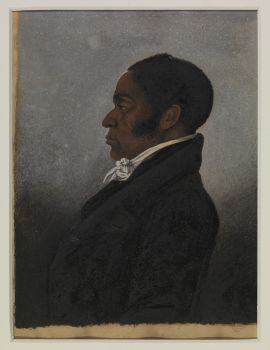
James Forten was born as a free man in September 02, 1766 in Philadelphia, Pennsylvania.
In his early teen years, James Forten participated in the American Revolutionary War where he served as a powder boy and was captured by the British Army. Later, he returned to his old job in Robert Bridges’ Sail Loft and was appointed as the successor of Bridges’ loft once he decided to retire.
Forten made large contributions to American capitalistic system with his work. In addition to being a well- recognized and wealthy African-American businessman of his time, Forten was also interested in politics. Throughout the course of his life, Forten advocated for the freedom of slaves and allied with other activists of his time to emancipate slavery.
James Forten died on March 04, 1842.
In this short annotated bibliography, I will provide a collection of sources proving that, although James Forten is long gone, his legacy continues on into the 21st century. These academic works reminds us of the honorable man he was and the amount of work he did as an abolitionist throughout his life.
Pt. I: Literature Written During James Forten’s Life:
“James Forten.” The Liberator, 17 Sept. 1841. Boston, MA. accessible.com/accessible/emailedURL?AADoc=THELIBERATOR.LI1841091727.00027 .
In this news article, a tribute is paid to the hard work of James Forten of the cause of the abolishment of slavery. This news article includes a personal letter from Forten addressed to Mr. WM. Lloyd Garrison discussing his health and how it had been deteriorating, but that did not mean that his will to keep working for their cause because it remain “undiminished and as ardent as ever.”
Minutes of the State Convention of the Coloured Citizens of Pennsylvania: Convened at Harrisburg, December 13th and 14th, 1848. Pg. 12-22. Merrihew and Thompson, 1849.
This book writes that of the convention of Pennsylvania concerning its “coloured citizens.” The convention united to pursue a lawsuit against the state of Pennsylvania for denying the people of color their right to vote. The attendants of the committee write that they have been denied the right to vote as well as the rights to pursue a life of freedom and wealth because they are people of color. The convention uses James Forten as an example of a “strong case for the purpose of disabusing your minds of the false views that have been circulated, that we were disfranchised on account of our condition (17).” This convention calls for action from the people in power to change the laws, as well as common people who are suffering from the same struggles by publishing this written version of call-for-action the North Star.
Mott, James, and Lucretia Mott. James and Lucretia Mott, Life and Letters. Edited by Anna Davis Hallowell, Houghton, Mifflin & Co., 1884.
This collection of letters between James and Lucretia Mott, are of their lives in Philadelphia during anti-slavery movement. These letters convey Lucretia Mott’s importance during her time as an abolitionist of slavery, she writes of the anti-slavery movement as well a women’s rights. She attended James Forten’s funeral as he had passed away during her time in Philadelphia. She also writes of spending her times at meetings in James Forten’s home along others in accordance to discuss the issues of abolishing slavery.
Rubens Ames, Julius, and Benjamin Lundy. The Legion of Liberty! And Force of Truth, Containing the Thoughts, Words, and Deeds of Some Prominent Apostles, Champions and Martyrs. Pg. 183. American Anti-Slavery Society, 1843.
The Legion of Liberty is written to honor those who have fought for liberty and justice in the United States. The volume has dedicated a section just for James Forten, where it is explained what he is well-known for during his lifetime and the changed he advocated for in his community. The book is published a year after James Forten has passed and it pays him a tribute for the passion and deep-interest in anti-slavery and because “he felt it to be a duty and a pleasure to give his warm and liberal support to that band of self-sacrificing men, that had organized to labor for the redemption of his brethren in bonds (183).”
Pt. II: Literature Written on James Forten Since 2000
JED GRAHAM. Forten, The Freedom Skipper Hoist Grand Ideas: The sail-winch inventor put race relations on the right course. Investor’s Business Daily, February 25, 2008 Monday. https://advance-lexis-com.intra.mills.edu:2443/api/document?collection=news&id=urn:contentItem:4RWW-HD90-TX4P-W1H3-00000-00&context=1516831. Accessed December, 2018.
Forten, The Freedom Skipper Hoist Grand Ideas, was written as a tribute to honor Forten’s work during the American revolution. He had risked his life and freedom during the Revolution if he were be caught by the British, which he was. Forten was offered a deal with the British and he refused to honor his patriotism with America and served a sentence of imprisonment. Forten is now considered one of the most influential first civil rights leader and his integrity and success earned him the reputation he now received centuries after his death.
Moonan, Wendy. Divided by a Revolution, United in Servitude. The New York Times, July 8, 2005 Friday. https://advance-lexis-com.intra.mills.edu:2443/api/document?collection=news&id=urn:contentItem:4GK6-MBK0-TW8F-G24G-00000-00&context=1516831. Accessed December 14, 2018.
In this article, Moonan writes about the African-Americans uniting with the patriots for the cause of freedom against Britain. However, the commander of the Continental Army, George Washington, did not want blacks in the army. But after the royal governor of Virginia offered freedom to all of those who joined the cause and Washington quickly changed his mind, for every 5,000 black men in the army, there was 60 whites. One of those men included James Forten who proclaimed his loyalty to his country, “I never, never shall prove a traitor to her interests!
Robert Flatley. The Forgotten Fifth: African Americans in the Age of Revolution. Library Journal Reviews, March 1, 2006. https://advance-lexis-com.intra.mills.edu:2443/api/document?collection=news&id=urn:contentItem:4JC5-7W30-TWGX-9249-00000-00&context=1516831. Accessed December 14, 2018.
This short article reviews the book, The Forgotten Fifth: African Americans in the Age of Revolution, by Gary B. Nash. Flatley describes the essence of the book and how Nash’s purpose was to highlight the importance of African-Americans during the revolutionary war. As Nash writes, African-Americans made up a fifth of the population during the revolutionary times and they fought in the war with the hopes of freedom. However, their freedom was not granted because the beliefs on slavery would split the nation. Nash’s book also explores the life and influence of African-Americans of the time such as James Forten.
Winch, Julie. A Gentleman of Color: the Life of James Forten. Oxford University Press, 2002.
Julie Winch writes James Forten’s biography in the 21st century. She writes about his life and his influence in American Politics as a free-born African American during the times of slavery. Winch writes about forten’s accomplishments as a sailmaker and his influence in the anti-slavery movement all throughout his life.
Pt. III: James Forten on Today’s Popular Media
Historical Abolitionist of the Month: James Forten. US Official News, June 16, 2015 Tuesday. https://advance-lexis-com.intra.mills.edu:2443/api/document?collection=news&id=urn:contentItem:5G7G-FW71-DXCW-D3YP-00000-00&context=1516831. Accessed December, 2018. L
On June 2015, James Forten was named Abolitionist of the Month. A short background of his life as a veteran of the revolutionary war and as a businessman is given in the article as well as what makes him a great Human rights advocate of his time. Forten ran his business without slavery interactions, which was very bold and progressive during this time. “Forten instilled in his children the importance of freedom and eradicating slavery, leaving a strong and multi-generational legacy of tenacious abolitionists.”
In this melody by Danny O’flaherty sings of freedom and narratives James Forten’s effort to bring freedom to his country with his work as a sail-man and as an abolitionist.
MEGAN TRIMBLE The Associated Press. 45-foot ship to tell story of American Revolution. Telegraph Herald (Dubuque, IA), August 7, 2016 Sunday. https://advance-lexis-com.intra.mills.edu:2443/api/document?collection=news&id=urn:contentItem:5KDT-NN21-JCDM-J02N-00000-00&context=1516831. Accessed December, 2018.

This news article from 2015 introduces the new exhibit in the Museum of the American revolution. The museum crew has built a 45-foot ship to remind us of the history from the Revolution, especially that of African-Americans and whites fought side by side for the same cause on ships. This exhibit also pays tribute to James Forten as he was a wealthy businessman from Philadelphia who also fought in the war and was an active abolitionist in the anti-slavery movement during his time.
Long Before King, ‘Letters From a Man of Colour’. The Huffington Post, September 26, 2013 Thursday. https://advance-lexis-com.intra.mills.edu:2443/api/document?collection=news&id=urn:contentItem:59FF-DT41-JCMN-Y2CN-00000-00&context=1516831. Accessed December, 2018.
The Huffington Post published the article, “Long Before King, ‘Letters From a Man of Colour,’” in order to inform the readers of James Forten’s purpose with these letters. After the American Revolutionary war, the state of Pennsylvania had multiple bills that would reinstate slavery in the state, so James Forten wrote letters published in a pamphlet as “Letters From a Man of Color” under a pseudonym in order to critique these bills as he was not able to do so openly as an African-American man during this time. In one of the letters, Forten writes, “Has the God who made the white man and the black, left any record declaring us a different species? Are we not sustained by the same power, supported by the same food, hurt by the same wounds, wounded by the same wrongs, pleased with the same delights and propagated by the same means? And should we then not enjoy the same liberty, and be protected by the same laws?”
Pt. IV: Events impacting African-Americans during James Forten’s lifetime
“Missouri Compromise.” Planning D-Day (April 2003) – Library of Congress Information Bulletin, Primary Documents in American History, www.loc.gov/rr/program/bib/ourdocs/missouri.html.
The Missouri ompromise of 1820 admitted Missouri state into the United States as a slave state, while also admitting Maine as a free state. This compromise was controversial because slavery was prohibited in the Louisiana territory, except for Missouri. However, it was repealed in 1854, and considered unconstitutional with the Kansas-Nebraska Act. These acts affected African-Americans who lived in slave states because they were bound to slavery without a choice, by the laws of Congress.
“Slavery, the American Revolution, and the Constitution.” Digital History, www.digitalhistory.uh.edu/active_learning/explorations/revolution/revolution_slavery.cfm.
After unfair treatment and taxation, the American Patriots from the 13 Colonies revolted against the British government leading to a revolution from 1775 all through 1783.In November 1775, Congress excluded African-Americans from enlisting in the revolution in order to honor the opinion of Southern slaveholders. However, those who fought in the war with the British were promised their freedom, so congress had to revisit their decision. Around 5,000 African-Americans fought in the revolutionary war, but their freedom was not guaranteed.
“The Bill of Rights: A Brief History.” American Civil Liberties Union, ACLU, www.aclu.org/other/bill-rights-brief-history.
In the summer of 1787, Congress met to ratify a new document for the common man in America. The Bill of Rights granted the American people a list of rights they were guaranteed to have such as the freedom of speech, right to bear arms, privacy and due process of law. However, The Bill of Rights was deeply flawed and did not benefit everyone in the United States, as only whites were given these rights as citizens.
TWC. “The Importance of the Declaration of Independence to African-American Liberation.” Theweeklychallenger.com, The Weekly Challenger, 16 Aug. 2018, theweeklychallenger.com/the-importance-of-the-declaration-of-independence-to-african-american-liberation/.
On July 4, 1776, the representatives of the 13 Colonies signed the Declaration of Independence. Although thousands of African-Americans fought in the war, very few were granted their freedom. This led to controversy in the Declaration of Independence at it states that “all men are created equal,” but a large number of representatives in the American colonies owned slaves themselves.
 Beatriz's Blog